
Fernando de Noronha
Environmental Conservation Landmarks
The Fernando de Noronha Archipelago, together with Rocas Atoll and the São Pedro and São Paulo Archipelago represent a large part of the insular surface of the South Atlantic, playing a fundamental role in the reproduction, dispersal and colonization of marine organisms in this region. As a result, it received two UNESCO titles, which should guarantee him greater environmental protection.
The Environmental Protection Area of Fernando de Noronha – Rocas – São Pedro and São Paulo was established by Decree Number 92.755, dated June 5, 1986, with the following main objectives:
- Protect and conserve the environmental quality and living conditions of fauna and flora.
- To reconcile organized tourism with the conservation of natural resources.
- Align the human occupation on the Archipelago to the protection of the environment.
The Decree Number 96.693, dated September 14, 1988, creates the established Fernando de Noronha Marine National Park with the following objectives: protect representative sample of the marine and terrestrial ecosystems of the Archipelago; ensure the preservation of its fauna, flora and other natural resources; provide controlled opportunities for scientific research, environmental education and public visitation; contribute to the protection of sites and structures of historical and cultural interest.
Tourism
Until 1990, the main economic occupation of the local population was public service, but, since that year, tourism has been growing, becoming an important source of economic income and the islanders have been improving and professionalizing the tourist service.
To know more about Tourism: www.noronha.pe.gov.br
Within the Environmental Protection Area (APA) and the Marine National Park (Parnamar) of Fernando de Noronha, you must also comply with the following rules:
- It is only allowed to visit the National Marine Park between 8am and 6pm, with the exception of the Dolphin Outlook which is from 6.30am to 6pm.
- Only use licensed vessels and vehicles.
- It is forbidden to camp, to stay overnight, to light fires on the beaches and to write or spray rocks, trees or signs.
- Respect and do not kill, capture, chase or feed the animals.
- Leave shells, corals, rocks, parts of animals and vegetables where they are.
- It is forbidden to leave trash, debris, and cigarette butts behind.
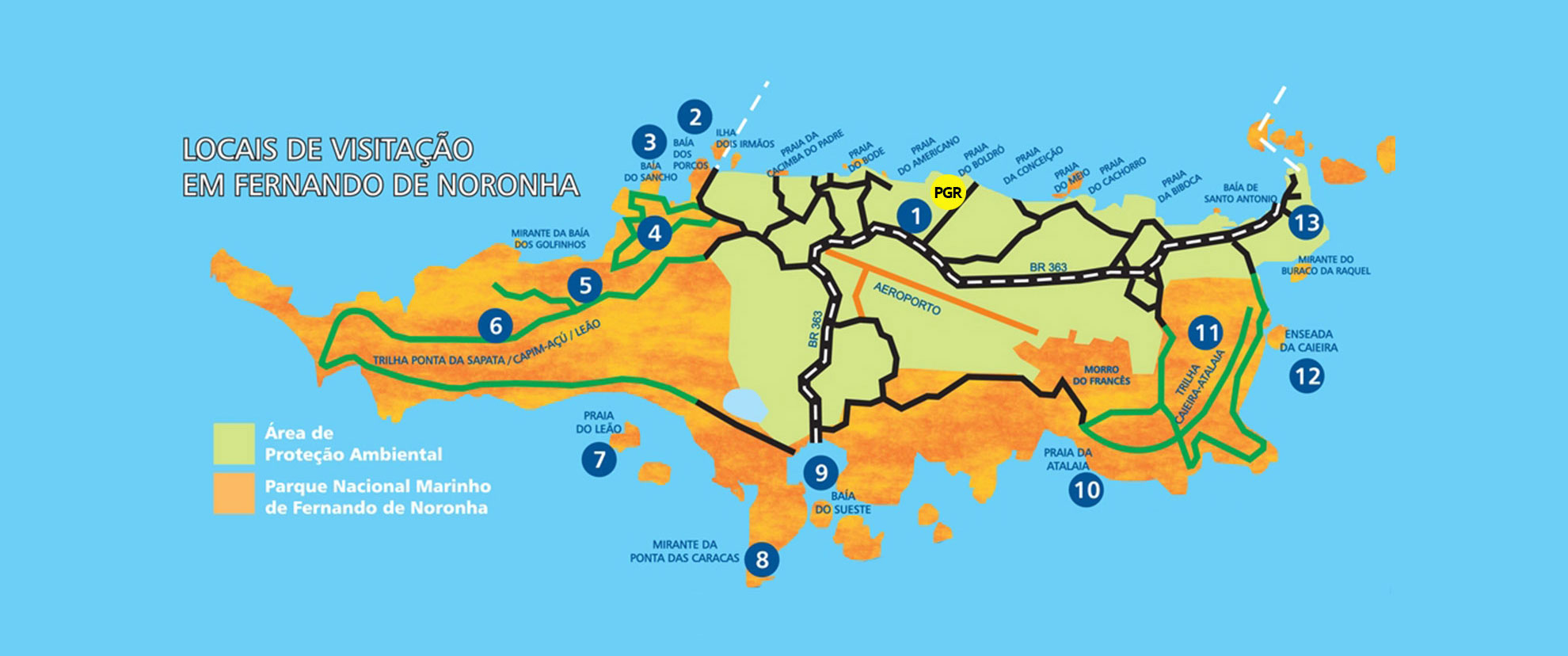
- PGR: Spinner Dolphin Project Headquarters
- ICMBio – Headquarters of the Fernando de Noronha National Marine Park, the Environmental Protection Area and the Tamar Project.
- Baía dos Porcos –
- Baía do Sancho – Swimming or diving outside the bay’s boundaries is prohibited. Touching the corals is forbidden; they sting and can cause death due to the pressure of hands and fins.
- Trilha Baía dos Golfinhos / Baía dos Porcos – No guide is necessary, but leaving the trail is not permitted. Observe dolphins and nests of seabirds such as terns, white-winged stilts, and black-crowned moorhens.
- Mirante dos Golfinhos – It is forbidden to descend the cliff, swim, or dive in Dolphin Bay. From the viewpoint, it is possible to observe abundant marine life, both in the water and the birds in the trees.
- Trilha Ponta da Sapata / Capim-Açu / Leão ( Trail from Ponta da Sapata / Capim-Açu / to Lions Beach) – Visitors are only allowed with guides accredited by the ICMBio. High degree of difficulty.
- Praia do Leão (Lion’s Beach) – This oceanic beach of Noronha is preferred by the green turtles to spawn. It is forbidden to touch or walk on the reefs. Watch carefully the currents of the sea.
- Mirante da Ponta das Caracas (Ponta das Caracas Outlook) – View allowed only from the belvedere, it is forbidden to descend the cliff.
- Baía do Sueste – When open for diving or swimming, respect the buoy limits, do not walk on the reefs, and do not enter the mangroves.
- Praia do Atalaia – Visits are coordinated by Parnamar-FN at pre-established times, according to the tide. Diving is permitted without the use of footwear, fins, sunscreen and/or similar items. Walking on the reefs is not allowed.
- Trilha Caieira-Atalaia – Visits are authorized with an inspector or guide authorized by ICMBio.
- Enseada da Caieira (Caieira Cove) – This is the least accomplished, most dangerous and most beautiful dive from the island. Rough sea and strong currents. Rich marine biodiversity, spot for the fin-shark.
- Buraco da Raquel (Rachel’s Hole) – It is only allowed to view from the belvedere, it is forbidden to go down the cliff.